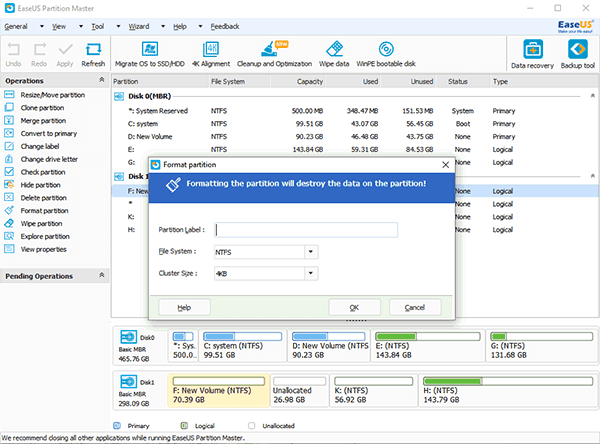
Since these file systems are key to the operating system making sense of the data, an OS cannot read data off of a disk without support for the file system with which the disk is formatted. When you format a disk, the file system you choose essentially governs which devices can read or write to the disk. HP USB Disk Storage Format Tool is one of the best free USB flash drive formatter software for Windows. It comes with two types of file format systems, namely, FAT32 and NTFS. In addition, Quick Format and Enable Compression options are also available to perform formatting on USB flash drive.
Zip files are files that have been grouped together and digitally shortened to consume less space. This makes storing and transporting the files easier. It is very simple to create a zip file. These are the three most common ways on how to zip files.
- Windows and Mac computers ship with the ability to create zip files out of the box. No special software is needed.
- A 3rd party software like the popular WinZip, WinRAR, 7Zip or other.
- A free online file zipping tool.
Zipping in Microsoft Windows
How to Format a Flash Drive. This wikiHow teaches you how to change your flash drive's default file format. Formatting your flash drive will typically remove any files or folders on the drive, so make sure you back up your files before. Download and Run USB Disk Storage Format USBFormat.zip (34KB) Step 3 Download grubinstgui grub4dos.zip (179KB) and Run as Administrator. Step 4 Insert the BootCD (10.3 or newer) in the CD Drive and Copy everything from CD to USB Flash Drive. Step 5 Copy grldr and menu.lst from grub4dos.zip (or from HBCD folder) to the usb drive.
The following directions are posted at the Microsoft support website: https://support.microsoft.com/en-us/help/14200/windows-compress-uncompress-zip-files
- Locate the file or folder that you want to zip.
- Press and hold (or right-click) the file or folder, select (or point to) Send to, and then select Compressed (zipped) folder.A new zipped folder with the same name is created in the same location. To rename it, press and hold (or right-click) the folder, select Rename, and then type the new name.
An example on YouTube:
Zipping in Apple Mac
The following directions are posted at the Microsoft support website: https://support.apple.com/kb/PH19074?locale=en_US
Compress a file or folder: Control-click it or tap it using two fingers, then choose Compress from the shortcut menu.
If you compress a single item, the compressed file has the name of the original item with the .zip extension. If you compress multiple items at once, the compressed file is called Archive.zip.
An example on YouTube:
Zipping with 3rd Party Software
We pretty much assume that if you bother using 3rd party software for zipping files, that you know how to zip files. Please refer to the instructions that came with the software. ;D
Zipping with an Online Service
WARNING: Free services like these can be handy at times. However, be warned… Your files will be accessible to the administrators of the service. Make sure you review the privacy policy and that you trust the service.
Step 1
Connect USB Pen Drive (1GB or more)
Step 2
Download and Run USB Disk Storage FormatUSBFormat.zip (34KB)
Step 3
Download grubinst_guigrub4dos.zip (179KB) and Run as Administrator
Step 4
Insert the BootCD (10.3 or newer) in the CD Drive and Copy everything from CD to USB Flash Drive
Step 5
Copy grldr and menu.lst from grub4dos.zip (or from HBCD folder) to the usb drive
Step 6
Test Your USB Drive (read bottom of the page for troubleshoot)

Make sure you set your computer to boot from USB Flash Drive
To Enter the BIOS press the 'Del' button on your keyboard. Alternatives are'F1', 'F2', 'Insert', and 'F10'. Some PC's BIOS might even require a differentkey to be pressed. Commonly a PC will show a message like'Press [Del] to enter Setup' to indicate that you need to press the 'Del' key.Some AMI BIOS require you to enable the option 'USB Keyboard Legacy support'!
For AMI BIOS:
- Go to 'Feature Setup'. 'Enable' these options: 'USB Function Support',
'USB Function For DOS' and 'ThumbDrive for DOS'. Go to 'Advanced Setup'.
Set the '1st Boot Device' to 'USB RMD-FDD'.
Reboot the PC and it now should boot from the Usb Stick. - Go to 'USB Mass Storage Device Configuration'. Select 'Emulation Type'
and set it to 'Harddisk'. Go to the 'Boot Menu' and set the '1st boot device' to 'USB-Stick'. Exit the BIOS, saving the changes.
you can try 'Emulation Type' to 'Floppy' or 'Forced FDD'.
For PHOENIX/AWARD BIOS:
- Go to 'Advanced BIOS Features'. Go to the '1st Boot device' and set it to 'USB-ZIP'.
Usb Format.zip
Troubleshoot
Usb Format Ps3
If you cannot install grub4dos (or you get 'cannot run background program' message) then use syslinux to boot grub4dos